Wednesday, 31 December 2025

Pure Health from Nature with Valluvam Cold Pressed Oils

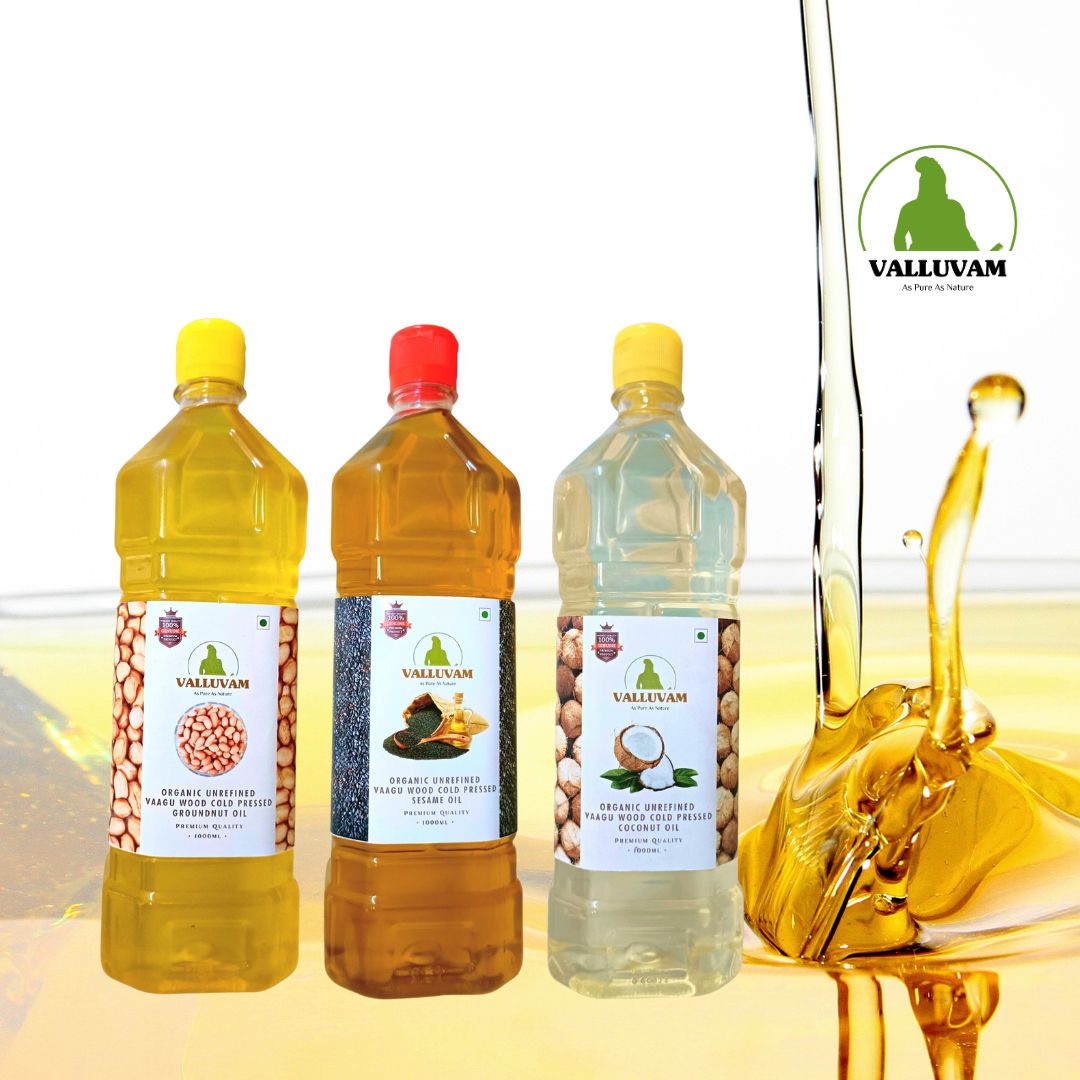
 In today’s health-conscious world, choosing the right cooking oil is essential for overall wellness. Valluvam Products brings you traditionally made, pure and natural oils that preserve nutrition and taste. Our range includes cold pressed coconut oil, sesame oil, and groundnut oil, crafted using age-old wooden extraction methods to retain maximum health benefits.

Benefits of Cold Pressed Coconut Oil

The benefits of cold pressed coconut oil are unmatched when it comes to daily nutrition. Rich in healthy fats and antioxidants, it supports heart health, boosts metabolism, improves digestion, and strengthens immunity. Cold pressed coconut oil is also excellent for skin and hair care, making it a versatile natural solution for overall well-being.

Health Benefits of Sesame Oil

The health benefits of sesame oil include improved bone strength, better blood circulation, and enhanced digestion. Packed with essential minerals like calcium, magnesium, and iron, sesame oil is widely used in traditional Indian cooking and oil pulling practices. It also helps maintain healthy cholesterol levels and supports joint health.

Cold Pressed Groundnut Oil Benefits

When it comes to everyday cooking, the cold pressed groundnut oil benefits stand out. This oil is rich in vitamin E and healthy fats, promoting heart health and providing sustained energy. Its natural aroma enhances food flavor while remaining light on digestion.

Choose Valluvam cold pressed oils for purity, tradition, and health. Eat clean, cook naturally, and live healthier — one drop at a time.

blogoil.jpg

Wednesday, 24 December 2025

Market Garden in a Closet: Scaling a Microgreen Business from Home

 Introduction


Imagine a farm that requires no tractors, no acres of land, and no heavy labor under the scorching sun. Imagine a harvest cycle that doesn't take months, but merely days. This isn't a scene from a sci-fi movie; it is the reality of modern urban agriculture. In the bustling cities of India, a quiet revolution is taking place inside spare rooms, balconies, and even repurposed closets. This is the world of microgreens—tiny plants with massive potential.


For decades, agriculture was seen as the domain of rural landscapes. However, the rise of microgreens farming in India has democratized the ability to grow food. Whether you are a student, a homemaker, or a corporate professional looking for a meaningful side hustle, the barrier to entry here is incredibly low. At IGO Agritechfarms, we have witnessed firsthand how small spaces can be transformed into profitable "market gardens," supplying highly nutritious superfoods to a health-conscious market.


The Tiny Titans: Understanding the Product


Before diving into the business mechanics, it is essential to understand what makes these tiny greens so valuable. Microgreens are vegetable greens harvested just after the cotyledon leaves have developed (and one set of true leaves). They fall somewhere between a sprout and a baby green.


But why is the market clamoring for them? The answer lies in their density—both in flavor and nutrition.


Nutritional Superiority Research has consistently shown that these miniature plants are far more nutrient-dense than their mature counterparts. For instance, red cabbage microgreens can contain up to 40 times more Vitamin E and six times more Vitamin C than mature red cabbage.


Culinary Versatility Chefs love them for the visual pop and intense flavor burst they add to dishes. A pinch of radish microgreens adds a peppery kick to a salad, while pea shoots offer a fresh, sweet crunch to stir-fries.


Why the Indian Market is Ready


The demand for clean, chemical-free food in India is at an all-time high. Urban families are scrutinizing labels and seeking immunity-boosting foods. This shift has created a fertile ground for new agri-entrepreneurs.


Health Consciousness: Post-pandemic, the focus on preventative health has skyrocketed.

Gourmet at Home: With the rise of home chefs and food blogging, people want access to premium ingredients that were previously available only in 5-star hotels.

Space Efficiency: In cities like Mumbai, Bangalore, and Chennai, space is a premium. Microgreens offer the highest yield per square foot of any crop, making them the perfect urban farming solution.

The Business of Greens: Low Risk, High Reward


One of the most attractive aspects of this venture is the minimal capital expenditure. You do not need to buy land or expensive heavy machinery. A basic setup can be established on a simple shelving unit.


When drafting a microgreens business plan, you will quickly notice that the operational costs are largely variable—seeds, growing medium, and packaging. This allows you to scale up or down based on demand without sinking funds into fixed assets.


Key Financial Advantages:


Short Cash Flow Cycle: Unlike traditional crops that take 90 days to harvest, microgreens are ready in 7 to 14 days. This means you can reinvest your profits weeks after starting, rather than months.

Premium Pricing: Due to their delicate nature and short shelf life, microgreens command a premium price in the market. Selling directly to customers or restaurants allows farmers to retain high margins.

Year-Round Cultivation: Indoor farming protects your crop from pests, monsoon floods, and scorching heat, ensuring a consistent supply 365 days a year.

Success Story: From IT Professional to Urban Farmer


At IGO Agritechfarms, we believe the best way to understand the potential of this business is through the eyes of those who have walked the path.


Meet Rajesh (name changed for privacy), a software engineer from Chennai. Like many, Rajesh spent his days glued to a screen, feeling disconnected from nature. He had a 10x10 ft spare room in his apartment that was gathering dust. He approached IGO Agritechfarms with a simple question: "Can I really grow food in here?"


We helped Rajesh set up a vertical rack system. He started small, with just four trays of radish and sunflower microgreens. The first harvest was for his family. The taste was unlike anything they had bought from the supermarket—fresh, crunchy, and intense.


Encouraged by the quality, Rajesh brought a few boxes to his office. They sold out by lunch. Realizing the potential, he scaled up.


Become a member

Rajesh’s Journey:


Month 1: Learning the basics of seed density, watering cycles, and light requirements.

Month 3: utilizing the full vertical space of his spare room. He was now producing 40 trays a week.

Month 6: He secured a contract with a local health cafe and a neighborhood organic store.

Today, Rajesh harvests over 15 kgs of greens weekly from that single room. "It’s not just about the extra income," Rajesh tells us. "It’s the satisfaction of seeing life grow before work every morning. It changed my relationship with food."


Setting Up Your Market Garden


Starting is easier than you might think. Here is a simplified roadmap to getting your first batch running.


1. The Setup You need a well-ventilated space. A wire rack shelving unit is ideal as it allows air to circulate and light to penetrate all levels. For lighting, standard T5 LED shop lights are sufficient for most microgreens, keeping electricity costs low.


2. The Medium Coconut coir is the industry standard for microgreens farming in India. It is sustainable, holds moisture well, and is sterile, reducing the risk of mold.


3. The Process


Soaking: Larger seeds like peas and sunflowers need soaking overnight to jumpstart germination.

Sowing: Spread seeds densely across the tray. This isn't traditional farming; we want a carpet of green.

Blackout: Stack the trays or cover them to simulate being underground. This forces the stems to stretch and grow strong.

Light: After 2-3 days, expose them to light. Watch them turn a vibrant green within hours.

Harvest: Cut just above the soil line when the first true leaves appear.

Marketing Your Harvest


Growing is only half the battle; selling is where the business happens. Because microgreens wilt quickly, your supply chain must be short and efficient.


Subscription Models: This is the "Holy Grail" of the microgreen business. A weekly subscription box for local residents ensures predictable revenue and minimizes waste.

Restaurant Partnerships: Approach local chefs with free samples. Freshness is your selling point. A chef will always choose a local farmer who delivers live trays over a distributor whose greens have been in transit for days.

Farmers Markets: These are great for brand visibility and educating customers directly about microgreens benefits.

Scaling Up with IGO Agritechfarms


While starting is simple, scaling requires strategy. Managing humidity control, preventing mold in large setups, and automating watering systems are challenges that arise as you grow.


This is where IGO Agritechfarms steps in. We don’t just sell equipment; we build agrarians. Our team provides end-to-end support, from designing your vertical farm layout to sourcing the highest quality non-GMO seeds. We help you navigate the transition from a hobbyist to a commercial grower.


We understand that every home is different. Whether you have a balcony, a garage, or just a closet, we customize solutions to maximize your yield. Our goal is to create a network of decentralized urban farms that feed their local communities, reducing food miles and increasing food quality.


Conclusion


The concept of a "market garden in a closet" challenges the traditional notion of what a farm looks like. It proves that you don't need acres to be an agriculturalist; you just need dedication and a few square feet.


Press enter or click to view image in full size


The microgreen revolution is here, and it is accessible to everyone. It offers a path to financial independence, better health, and a deeper connection to what we eat. The seeds of opportunity are in your hands. Are you ready to plant them?


Tuesday, 23 December 2025

Celebrating Excellence in Farming Innovation at IGO Agritech Farms

 We are delighted to share a proud and inspiring milestone in the journey of IGO Agritech Farms, India’s leading farming conglomerate. Our visionary leader, Dr. John Yesudhas, Founder & CEO of IGO Agritech Farms, has been honored with two prestigious national recognitions — “Best CEO in the Farming Sector” and “Best Tech Farming Company” — at the 2025 India Business Conclave, presented by the Global Triumph Foundation.

A Testament to Visionary Leadership in Agri-Tech

These awards recognize Dr. John Yesudhas’s unwavering leadership, forward-thinking vision, and relentless commitment to transforming Indian agriculture through technology-driven and sustainable farming solutions. Under his guidance, IGO Agritech Farms has grown into a trusted name in modern agriculture, delivering end-to-end farming solutions across polyhouse farming, hydroponics, open cultivation, joint ventures, and advanced agri-infrastructure projects.

At IGO Agritech Farms, innovation is at the core of everything we do. Our tech-enabled farming models empower farmers, investors, and a


gripreneurs to achieve higher productivity, improved profitability, and long-term sustainability. This recognition strengthens our resolve to continue setting new benchmarks in the agri-tech sector while supporting India’s farming community with reliable, scalable, and future-ready solutions.

Gratitude and the Road Ahead

We extend our heartfelt gratitude to our valued clients, partners, team members, and supporters who have been an integral part of this success. Your trust and collaboration fuel our growth and vision.

As we celebrate this remarkable achievement, we move forward — together — towards a smarter, stronger, and more sustainable future in farming.

The journey continues…

Monday, 22 December 2025

IGO Group CEO Dr. John Yesudhas Meets Sri Lankan Officials to Explore Agri-Tech Partnerships

 IGO Group Expands Global Agri-Tech Vision with Sri Lanka Collaboration

IGO Group continues to strengthen its global footprint by exploring strategic agricultural collaborations with Sri Lanka. This initiative reflects the company’s long-term vision of transforming agriculture through technology, sustainability, and international partnerships.

As part of this global engagement, Dr. John Yesudhas, Founder & CEO of IGO Group, recently met with senior Sri Lankan officials, including the Minister for Natural Resources and Forestry and the Sri Lankan High Commissioner. The discussions focused on building mutually beneficial cooperation to enhance agricultural development, employment generation, and export growth.

IGO Group also shared its expertise in tech-driven farming and precision agriculture, offering scalable solutions that improve crop productivity, quality, and sustainability. These advanced farming models are designed to help Sri Lanka produce export-ready agricultural products that meet global quality standards while ensuring long-term environmental responsibility.

Another key focus area was enhancing import–export opportunities between India and Sri Lanka. Strengthening trade channels can boost bilateral economic ties and open new employment opportunities for youth in both countries, particularly in agriculture, manufacturing, and logistics.

In addition to economic initiatives, the discussions addressed humanitarian efforts. Rotary Tamilnadu highlighted disaster relief support for cyclone-affected regions in Sri Lanka, underscoring a shared commitment to social responsibility.

This collaboration marks an important step toward long-term agricultural cooperation. Through innovation, technology, and inclusive growth, IGO Group remains committed to empowering farming communities and strengthening cross-border partnerships.


Saturday, 20 December 2025

Top Mushroom Farming Company in India — Complete Guide to Mushroom Farming Projects & ROI

 Mushroom farming is rapidly becoming one of the most profitable agribusiness opportunities in India, offering fast returns, low land requirement, and year-round income. With rising demand for healthy food and indoor farming solutions, many investors are now searching for the top mushroom farming company in India to start reliable and scalable projects.

Mushroom Farming in India — Growing Business Opportunity

India’s mushroom market is expanding due to:

  • Increasing health awareness
  • High demand from hotels, supermarkets, and exporters
  • Low water usage and eco-friendly production
  • Short crop cycles with quick income generation

Mushroom cultivation is ideal for farmers, landowners, working professionals, and investors looking for passive income farming projects.

Top Mushroom Farming Company in India

Choosing the right company is critical for project success. The top mushroom farming company in India offers:

  • End-to-end project execution
  • Scientific cultivation methods
  • Technical training & farm management
  • Guaranteed buyback support
  • Proven ROI models

Among leading agritech brands, IGO Agritech Farms stands out as a trusted name delivering structured mushroom farming projects across India with strong technical and commercial backing.

Mushroom Farming Companies in Tamil Nadu

Tamil Nadu is one of the fastest-growing hubs for mushroom farming due to:

  • Suitable climate conditions
  • Strong local market demand
  • Availability of skilled manpower
  • Government support for agribusiness
Become a member

Professional mushroom farming companies in Tamil Nadu provide turnkey solutions including shed construction, spawn supply, training, and harvest support. Investors from Chennai, Coimbatore, Salem, Madurai, and Trichy are increasingly adopting mushroom farming as a stable income source.

Types of Mushroom Farming Projects

Oyster Mushroom Farming

  • Most popular and beginner-friendly
  • Grows well in Indian climate
  • Harvest in 20–30 days
  • Low investment, high demand

Mushroom Farming Project ROI (Return on Investment)

One of the biggest advantages of mushroom cultivation is its high ROI and quick break-even period.

Key ROI Benefits:

  • Short crop cycle (monthly income)
  • Low operating costs
  • Multiple harvests per year
  • Indoor, climate-controlled production

A professionally managed mushroom farming project ROI can range from 30% to 120% annually, depending on scale, mushroom variety, and market linkage. With buyback assurance and expert management, investors can enjoy predictable returns.

Why Choose a Professional Mushroom Farming Company?

Working with a reputed mushroom farming company ensures:

  • Scientific farm setup
  • Quality spawn and inputs
  • Consistent production
  • Market access & buyback
  • Reduced risk and higher ROI

This is why investors prefer structured projects offered by established agritech companies rather than experimenting independently.

Conclusion

Mushroom farming is one of the most future-ready agribusiness models in India, offering high returns, sustainability, and scalability. Whether you are searching for the top mushroom farming company in India, reliable mushroom farming companies in Tamil Nadu, or a project with assured mushroom farming project ROI, partnering with an experienced agritech provider is the key to success.


Wednesday, 17 December 2025

Stop Praying for Rain: Take Control with Protected Cultivation.

 Agriculture in India is undergoing a massive transformation. The traditional reliance on rain and open fields is giving way to a smarter, more predictable method: protected cultivation.

Polyhouse farming is rapidly emerging as the game-changer for Indian farmers and agri-investors. It’s not just about growing crops; it’s about guaranteeing high-quality yields, lowering risks, and securing premium market prices year-round.

If you are looking for the top polyhouse farming in India, searching for low-cost polyhouse farming ideas, or need a roadmap on how to start a polyhouse farming business, this guide is your starting point for a profitable agricultural future.

What Is Polyhouse Farming? (The Simple Explanation)

Think of a polyhouse as a protective shield for your crops. It is a specialized structure covered with UV-stabilized polyethylene sheets that creates a controlled environment inside.

Unlike open-field farming, where you are at the mercy of the elements, a polyhouse lets you regulate temperature, humidity, light, and water. This means you can grow high-value crops 365 days a year, regardless of whether it’s scorching hot or pouring rain outside.

Why India is Embracing the Polyhouse Revolution

India’s diverse climate is both a blessing and a challenge. Increasing demand for fresh, pesticide-free vegetables in urban areas, combined with erratic weather patterns, has created a massive need for consistent production. Polyhouse farming solves the biggest headaches of traditional agriculture: unpredictable weather, pest attacks, and water scarcity.

The Unbeatable Advantages of Protected Cultivation

Why are so many farmers making the switch? The math is simple:

Massive Yield Increase: Expect 3–5 times higher production compared to open-field cultivation in the same area.

Water Wisdom: It is incredibly efficient, saving up to 70% of water and fertilizers through precision drip systems.

Year-Round Income: Forget seasonal gaps. Grow and sell produce when market prices are highest.

Premium Quality: Crops grown in controlled environments are uniform, cleaner, and fetch premium prices in supermarkets and export markets.

Risk Reduction: Reduced dependency on the monsoon and significant protection from pests and diseases.

Because of these benefits, modern investors now consider protected cultivation the gold standard for sustainable agricultural returns in India.

Where the Money Is: Top Crops for Polyhouse Farming

Success in polyhouse farming starts with choosing the right crop. You don’t grow staples here; you grow high-value items with consistent demand.

The Most Profitable Options Include:

Exotic Vegetables: Colored Capsicum (Red, Yellow), Seedless Cucumbers, Broccoli, Cherry Tomatoes.

Leafy Greens: Hydroponic Lettuce, Basil, Rocket, and other salad greens.

Fruits: Strawberries and melons.

Floriculture: High-demand flowers like Gerberas, Roses, and Carnations.

Smart & Affordable: Low-Cost Polyhouse Farming Ideas
A common myth is that polyhouse farming requires crores of investment. That is simply not true. With smart planning, you can start small and scale up.

Here are practical low-cost polyhouse farming ideas for beginners:

Start Small: Begin with a 500–1,000 sq. ft. naturally ventilated structure to learn the ropes before expanding.

Choose the Right Type: A naturally ventilated polyhouse is significantly cheaper than a fully climate-controlled (fan and pad) system and works well for many crops.

Crop Selection: Start with fast-growing, resilient crops like cucumbers or leafy greens to generate cash flow quickly.

Leverage Subsidies: This is crucial. The National Horticulture Board (NHB) and various state governments offer heavy subsidies ranging from 50% to 70% on project costs.

Your Roadmap: How to Start a Polyhouse Farming Business

If you are ready to move from planning to execution, here is a structured approach on exactly how to start a polyhouse farming business:

Step 1: Site Selection You need flat land with excellent sunlight exposure, a reliable water source, and stable electricity. Proper drainage is a must to prevent waterlogging.

Step 2: Choosing the Structure Decide between a naturally ventilated polyhouse (lower cost, good for moderate climates) or a climate-controlled polyhouse (higher cost, necessary for extreme heat zones or highly sensitive crops).

Step 3: Crop & Market Planning Don’t plant first and look for buyers later. Analyze local demand, talk to vendors, and choose high-ROI crops with clear harvest cycles.

Step 4: Setup & Installation This involves constructing the GI (Galvanized Iron) structure, installing the UV film, setting up the drip irrigation/fertigation units, and installing shade/insect nets.

Step 5: Scientific Management This isn’t traditional farming. It requires strict adherence to irrigation schedules, nutrient management, and proactive integrated pest management.

Step 6: Harvesting & Marketing Establish tie-ups before harvest. Look at direct market supply, contract farming agreements, or B2B sales to hotels and supermarkets.

The Returns: Profit & ROI

While initial costs are higher than open farming, the returns justify the investment.

Average ROI: Typically ranges from 30% to over 100% annually, depending on the crop and management efficiency.

Payback Period: Most well-managed projects recover their initial investment within 2–3 years.

Why Go It Alone? Partner with Experts.

Polyhouse farming is highly profitable, but it is also technical. One wrong move with temperature or nutrients can affect your entire harvest.

To ensure long-term success, partner with experienced agritech professionals. IGO Agritech Farms is recognized for delivering complete A-to-Z polyhouse solutions across India.

We don’t just build structures; we build businesses. From designing the project and selecting the right crops to providing end-to-end farm management, 24/7 expert support, and even assured buyback options, we ensure your investment is secure.

Conclusion

Polyhouse farming is no longer limited to large corporations. With the right guidance, government subsidies, and smart planning, anyone can build a sustainable and highly profitable farming business.

Now is the perfect time to invest in protected cultivation.

 Modern Farming. Smart Investment. Guaranteed Growth.


Shaping the Future of Indian Agriculture Through Smart Horticulture

 Indian agriculture is witnessing a major transformation as farmers and investors move toward high-value, technology-driven farming models. ...